


Revealed: The Impact of POS Systems for Retail Stores on Business Efficiency
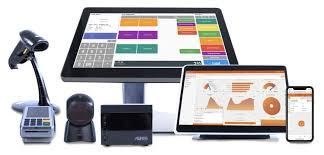
In an era where retail efficiency is paramount, the role of POS systems for retail stores has never been more critical. The Retail Point of Sale Terminals Market is projected to soar from $32.96 billion in 2024 to an impressive $125.22 billion by 2035. This staggering growth, characterized by a CAGR of 5.3%, not only reflects the rising demand for payment processing terminals but also showcases the transformative power of technology in retail environments. As businesses strive for operational excellence, the adoption of advanced retail checkout technology is becoming a priority.
The competitive landscape features companies like Verifone (US), Ingenico (FR), and Square (US), which are leading the charge in innovation by developing state-of-the-art smart POS devices. The landscape is further enriched by contributions from NCR Corporation (US) and PAX Technology (CN), which focus on integrating digital payment terminals with cutting-edge features. Firms like Clover (US), Diebold Nixdorf (US), Toast (US), and Zebra Technologies (US) are also pivotal in enhancing customer experiences through the implementation of user-friendly retail checkout solutions The development of POS systems for retail stores continues to influence strategic direction within the sector.
The drivers behind the Retail Point of Sale Terminals Market are multifaceted. One of the most significant factors is the increasing reliance on digital payment systems, which are simplifying transactions and providing consumers with more options. Retailers are also facing pressure to enhance their service offerings, which is pushing them to adopt more sophisticated POS systems. However, challenges persist, as the need for enhanced security features is paramount. Retailers must ensure that their systems are not only efficient but also secure, addressing concerns over data breaches and fraud.
North America remains the front-runner in the Retail Point of Sale Terminals Market, buoyed by a strong infrastructure and widespread acceptance of digital payment solutions. The U.S. market is particularly robust, thanks to the significant implementation of smart retail checkout solutions. Conversely, the Asia-Pacific region is emerging rapidly, driven by a surge in e-commerce and the increasing adoption of mobile payment systems. This dual growth underscores the global shift toward more integrated and consumer-friendly retail environments.
The current landscape presents substantial opportunities for growth. The integration of smart retail checkout solutions is likely to enhance operational efficiency and customer satisfaction. Companies that leverage innovative payment processing terminals to bridge the gap between digital and physical retail will likely thrive. According to Market Research Future, the demand for digital payment POS terminals is set to escalate, creating a fertile ground for new entrants and established players alike.
A recent report indicates that approximately 70% of retailers are planning to invest significantly in their POS systems over the next five years, emphasizing the urgency to stay competitive. This is particularly evident in sectors like grocery and hospitality, where streamlined transactions directly impact customer satisfaction and retention. For instance, grocery chains that implemented self-checkout systems reported a 15% increase in transaction speed, leading to enhanced customer throughput and reduced wait times. Moreover, a study revealed that businesses using advanced POS analytics saw a 20% increase in sales due to better inventory management and customer insights.
As we look to the future, the Retail Point of Sale Terminals Market promises significant growth, achieving an estimated value of $125.22 billion by 2035. Retailers are expected to continue evolving by adopting AI-driven solutions to enhance customer interactions and streamline operations. Experts foresee a continued focus on personalization and data analytics as critical drivers of future market dynamics.
AI Impact Analysis
AI and machine learning are becoming integral to the evolution of POS systems for retail stores. These technologies allow for better customer insights through data analysis, enabling retailers to tailor their offerings and enhance customer experiences. AI-driven analytics can optimize inventory management, ensuring that products are available when customers want them while also improving overall operational efficiency.

 English
 Arabic
 French
 Spanish
 Portuguese
 Deutsch
 Dutch
Dutch
 Italiano
 Russian
 Romaian
 Portuguese (Brazil)
 Greek
Greek
